Father's Last Letter

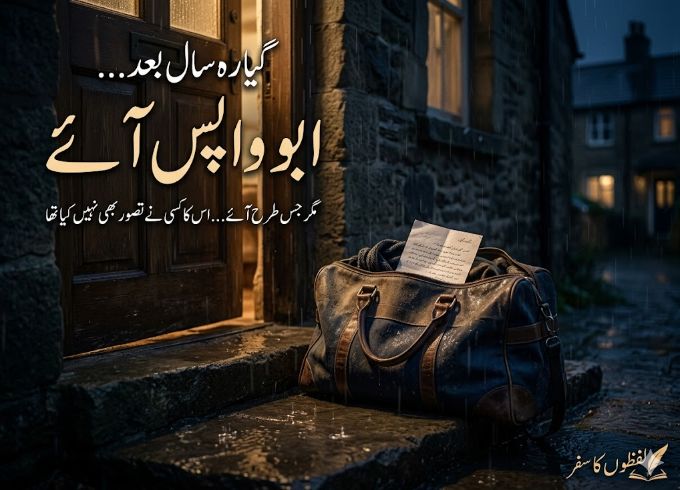
Story Title: "Father said I'd be back soon... but eleven years passed" I was only eight years old when Father, as he was leaving home, placed his hand on my head and smiled, saying: "Son, it's just a matter of a few months... then I'll be back." At that time, I didn't know that some "few months" can consume an entire childhood. Our house was small, but full of happiness. Father worked in a factory. The income wasn't much, but it was enough to keep the home running and allow us to dream. Then one day the factory closed. The household's circumstances began to change. Mother sold her jewelry. Father looked for a job in many places, but found no success. Finally, a relative advised him to go abroad. Father thought a lot. He didn't want to go, but perhaps some fathers think more about their children's future than their own wishes. On the day he left, I clung to him and wept. "Father, when will you come back?" He looked into my eyes and said: "I'll be back soon, son. You'll see, when I return, I'll bring you lots of toys." I laughed. Little did I know that I would spend the next eleven years living on the strength of those very words. For the first few months, Father's calls kept coming. Every time he would say, just a little more time. Then the calls became less frequent. Then they started coming months apart. Then only on Eids. And then... One day the calls stopped coming altogether. Mother would always say: "Your father is fine. He must just be very busy." I would believe it. Years passed. I grew older. My friends would go to the market with their fathers, take pictures, seek advice. And I? I just kept waiting. Sometimes I would look at the door, sometimes at the phone. Every Eid, while putting on new clothes, the same thought would come to my mind: perhaps Father would come this time. But he didn't come. One day I asked Mother: "Has Father forgotten us?" Hearing this, Mother immediately left the room. It was the first time I had seen her crying secretly. Time kept passing. I reached university. By now, waiting had become a habit. Then one night there was a knock at the door. It was eleven o'clock at night. When I opened the door, a strange man was standing in front of me. He had an old bag in his hand. He asked my name. I nodded yes. He extended the bag towards me. "This is your father's trust." A shock ran through my body. "Where is my father?" The man's eyes lowered. And the next few words changed my entire world. "Your father passed away eleven years ago." My breath caught. The bag fell from my hand. I looked at him in disbelief. "This is a lie..." But the man remained silent. Then he explained that Father had been in an accident abroad. He had no close relatives there, nor anyone who could immediately inform the family. Years passed amidst paperwork and complex circumstances. But before he died, he had entrusted a bag to his friend and said: "If you ever manage to reach my family, give this entrusted item to them." With trembling hands, I opened the bag. Inside were a few clothes. An old watch. And a letter. I opened the letter. It read: "My dear son... If you are reading this letter, then perhaps I could not return to you. I am sorry I couldn't fulfill my promise. But believe me... I never forgot you. I lived every day for you. With every breath, I worried about you. If I couldn't return, take care of your mother. And never think that your father abandoned you. I merely stopped on the way." The last words of the letter were blurred. Perhaps they were soaked with tears. For the first time, I understood that some fathers don't leave home... They lose themselves in search of a better future for their children. And some waits don't end... They just become memories. If this story has touched your heart, then perhaps you are also among those who understand the feelings hidden behind words. To read more such true, emotional, and heartwarming stories, install the "Islamic Tube Pro" app. Because here, every story is not just read... it is felt.

ارے بھائی!

اگر آپ ہزاروں کتابیں، نعتیں، تصاویر، ویڈیوز، اخبار، مضامین، قبلہ نما، اوقات نماز، اسلامک گھڑی اور بہت کچھ آسانی کے ساتھ حاصل کرنا چاہتے ہیں تو بس ہمارے Islamic Tube ایپ کو پلے سٹور سے انسٹال کرو، اور بالکل مفت اور آسانی کے ساتھ اسلامک مواد حاصل کرو

ڈاؤن لوڈ کریں
Image 1

A heart-wrenching story of a scholar

A heart-wrenching story of a scholar

Therefore, I narrate to you a strange and warning anecdote which I heard from Maulana Fatih Muhammad Sahib (may Allah have mercy on him). Maulana states that Sheikh Dahan (a oil merchant), who was a great scholar of Makkah Mukarramah, said that a scholar passed away in Makkah Mukarramah and was buried. After some time, another person passed away, and his heirs wished to bury him in the grave of that scholar. This is the custom in Makkah Mukarramah that they bury several deceased persons in a single grave over time. Consequently, when the grave of that scholar was dug up, people saw that instead of his body, the body of an extremely beautiful girl was lying there, and by appearance, she looked European. Everyone was astonished as to what the matter was. Coincidentally, a person who had come from Europe was also present in that gathering. When he saw the girl's face, he said, "I recognize her. This girl lived in France and was the daughter of a Christian. She used to study Urdu from me and had secretly accepted Islam. I had also taught her a few booklets on Islamic theology (Deeniyat). Coincidentally, she fell ill and passed away, and being heartbroken, I left my job and came here." People said, "The reason for her transfer here is understood—that she was a Muslim and pious. But now the question to be asked is, where did the body of that scholar go?" Some people suggested that perhaps the scholar's body had been transferred to that girl's grave. Upon this, people told the traveler, "When you return to Europe after completing the Hajj, dig up that girl's grave and see whether the body of the Muslim scholar is inside or not." They also sent someone along with him who could recognize the face. Accordingly, that person returned to Europe and narrated the situation to the girl's parents. They were greatly astonished, wondering how it was possible that the girl was buried in France and her body was seen in Makkah Mukarramah. Ultimately, it was decided to dig up the girl's grave. Consequently, her parents and a few people went to the cemetery to investigate this astonishing matter. When the girl's grave was dug up, her body was indeed not in her coffin; instead, the Muslim scholar was lying there exactly as he looked, the one who had been buried in Makkah Mukarramah. Sheikh Dahan stated that the traveler informed us through some source that the scholar's body was present there in France. Now the people of Makkah Mukarramah became worried. The girl's arrival in Makkah was a sign of her acceptance in the court of Allah, and the reason for her acceptance was known. But on what basis did this scholar reach the land of disbelief (Kufristan) from Makkah Mukarramah? What was the reason for his rejection? Everyone said that a person's true inner state is known to their family members, so his wife should be asked. Consequently, people went to his house and inquired, "Was there anything in your husband that was against Islam?" She replied, "Nothing at all. He was a regular at prayers, a reciter of the Quran, and performed Tahajjud (night prayers)." People said, "Think carefully and tell us, because his body has reached the land of disbelief from Makkah Mukarramah after burial. There must have been something against Islam in him." Upon this, the wife said, "Yes, there was one thing about him that always troubled my heart. It was that when he was intimate with me and intended to take a bath afterwards, he used to say: 'In the religion of the Christians, this thing is very good—that the ritual bath of impurity (Ghusl-e-Janabah) is not obligatory upon them.'" People said, "This is the very thing because of which Allah Almighty threw his body from Makkah Mukarramah to the place of the same nation whose way he preferred." Gentlemen, you saw that this person was outwardly a pious scholar and a complete Muslim, but upon investigation, it was revealed that one element of disbelief (Kufr) was present in him—that he preferred a practice of the disbelievers over an Islamic command, and to approve of or prefer disbelief is itself disbelief (Istihsan-e-Kufr Kufr hai). Therefore, he was not truly a Muslim from the beginning. It is not necessary that the body is transferred everywhere, but sometimes Allah Almighty demonstrates this to serve as a warning to people, showing that the result of an evil inner state is this. That is why I say that whoever becomes a disbeliever, there is some element of disbelief in them from the very beginning, which can be known to us too upon investigation and reflection, but we do not reflect. Hence, we say that a Muslim became an Arya (apostatized), whereas he was an Arya from the very beginning; Islam was not in him at all, but we were unaware of his evil state. Otherwise, a true Muslim can never become a disbeliever. This is why regarding Satan, the Almighty states: "Wa kana min al-kafireen" (And he was of the disbelievers). He did not become a disbeliever only at the moment of refusing to prostrate to Adam (A.S.); the secret of this has been described by the scholars of research through poetry: "It was written on the Tablet beforehand that one would become accursed, I suspected everyone else, but never suspected myself. Adam was made of dust and I was of His pure light, I thought I am unique, and he too was unique." Meaning, it was written in the Preserved Tablet (Lauh-e-Mahfuz) from the very beginning that at the time of Adam's (A.S.) creation, a certain person would disbelieve (i.e., his disbelief would manifest at that time). Satan, having read the Preserved Tablet, was aware of this event that a person was going to become a disbeliever. But it never occurred to him regarding himself that perhaps it could be him. He was completely unconcerned due to his obedience and worship, thinking, "How can such a great worshipper ever become a disbeliever? Never! It must be someone else." (Khutbat-e-Hakim-ul-Ummat Volume 22, pp: 368, 369) ____________📝📝____________ Book: Jawahir-e-Khutbat Page Number: 291-292-293 Compilation: Ustad-ul-Qurra Qari Zia-ur-Rahman Sahib Selection: Islamic Tube Pro App ____________📝📝____________