*(From the Pages of History)*

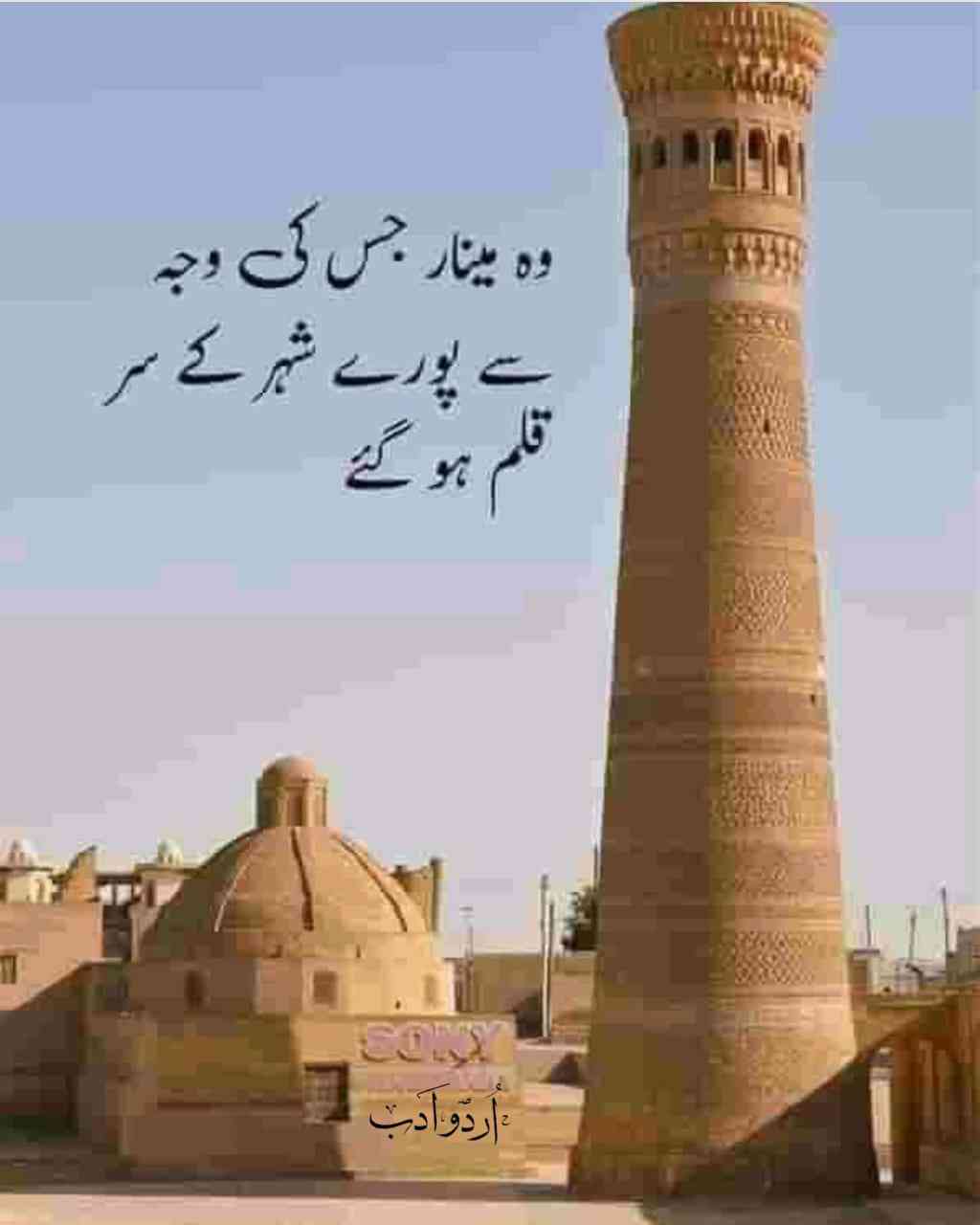
*🗼The Minaret Because of Which the Entire City Was Decapitated⚔️*

✍🏻It was the thirteenth century, an era of rebellions, and fire was raging everywhere. History tells us that Genghis Khan, while building minarets of skulls, reached Bukhara in 1220 AD and stopped in front of this minaret. The minaret was 46 meters high. When Genghis Khan looked up to see the highest point of the minaret, his turban fell off. He involuntarily bowed down to pick up the turban, and suddenly remembered his vow...

He had promised himself that he would never bow before anyone in his life, but a lifeless minaret of bricks made the world's greatest conqueror bow at its feet. He felt ashamed, picked up the turban, placed it on his head, and ordered that except for this minaret, all buildings in the entire city be demolished and everyone be decapitated. The Genghis army advanced, cut off the heads of the entire population of Bukhara, collected them in the Kalyan Mosque, made a minaret of skulls, coated it with human fat, and set it on fire. All the buildings in the city were also demolished...

Only the Kalyan Minaret, the ancient mosque of Bukhara, and the tomb of Ismail Samani survived. The minaret was saved courtesy of the turban, while the people had covered the mosque and the tomb of Ismail Samani with sand. Both of these buildings became mounds of sand and were saved. In Persian, "Kalyan" means big, and "Kula" means turban, so it is not clear whether this minaret is called Kalyan due to its height or Kula Minaret because of Genghis Khan's turban. However, it is certain that the building is so high that "the cap falls off the head." This proverb was born under the shadow of this very minaret... Today, the city of Bukhara is inhabited again, but even the grave of Genghis Khan is unknown. Someone rightly said, "When tyranny is erased, even the trace of the tyrant is lost."

📌 Copy & Paste

ارے بھائی!

اگر آپ ہزاروں کتابیں، نعتیں، تصاویر، ویڈیوز، اخبار، مضامین، قبلہ نما، اوقات نماز، اسلامک گھڑی اور بہت کچھ آسانی کے ساتھ حاصل کرنا چاہتے ہیں تو بس ہمارے Islamic Tube ایپ کو پلے سٹور سے انسٹال کرو، اور بالکل مفت اور آسانی کے ساتھ اسلامک مواد حاصل کرو

ڈاؤن لوڈ کریں
Image 1

The Unshakable Steadfastness of Hazrat Maulana Hussain Ahmad Madni

The Unshakable Steadfastness of Hazrat Maulana Hussain Ahmad Madni

Once, a case of treason was filed against Hazrat Maulana Hussain Ahmad Madni (R.A), and he was presented before the British court hall in Karachi. Maulana Muhammad Ali Jauhar and many other prominent leaders were also gathered there. The British officer called him and said, "Hussain Ahmad! This fatwa that you have given stating that joining the British army is Haram—this is not permitted. Do you know what its consequence will be?" Hazrat replied, "Yes, I know what its consequence is." He asked, "What is the consequence?" There was a white sheet (shawl) on Hazrat's shoulder. Hazrat pointed towards it and said, "This is its consequence." The British officer asked, "What do you mean?" He replied, "It is a shroud (kafan). I have brought it with me so that even if you sentence me to hang, I will have my shroud with me." Maulana Muhammad Ali Jauhar held Hazrat's feet and requested, "Hazrat! Please give a slightly ambiguous or double-meaning answer so that you can save yourself, because we need you greatly. You are the crown on our heads; we will not find elders like you again." But Hazrat Madni (R.A) possessed a wondrous glory at that moment. SubhanAllah! The British officer said, "Hussain Ahmad! What was the need for you to bring a shroud? The government itself provides a shroud to anyone it hangs." Hazrat Madni (R.A) replied, "Even though the government provides the shroud, I have brought my own shroud because I feel ashamed to go into the presence of Allah in a shroud given by the British. I do not want to take your shroud into my grave either." How great mountains of steadfastness our elders were! Allahu Akbar (Allah is the Greatest). By lineage, Hussain Ahmad Madni is a Sayyid... and is from the progeny of Hussain bin Ali (RadiAllahu Anhuma).