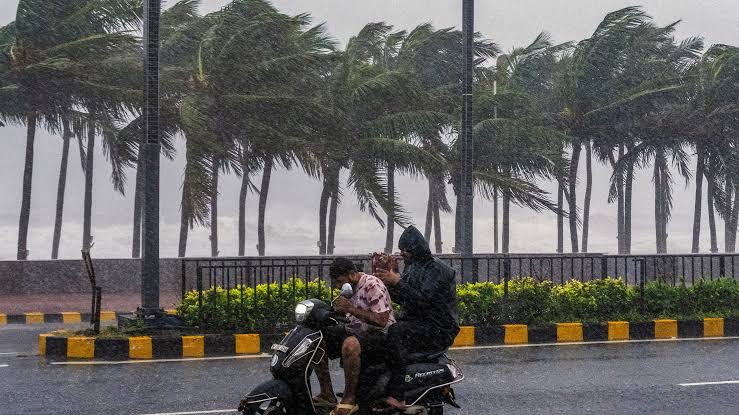
Before the impacts of Cyclone 'Arnab' could even fully subside, another storm warning has been issued for the Bay of Bengal. According to the India Meteorological Department (IMD), a depression formed over the bay is expected to intensify into a cyclonic storm. It is projected to move toward the Andhra Pradesh coast and make landfall on the morning of November 3. If it develops into a cyclone, it will be named 'Murasu', a name suggested by India. This could be the second cyclone to hit the Bay of Bengal this year.
Expected Wind Speeds
According to IMD Director General Mrutyunjay Mohapatra, the system is likely to generate wind speeds of 80 to 90 km/h, with gusts reaching up to 100 km/h.
Warning for Fishermen
Advised not to venture into the sea until the afternoon of November 4.
Those already at sea have been directed to return to the coast immediately.
Parts of the West-Central, South-East, and Central Bay of Bengal may prove extremely hazardous for boats and small vessels.
Regions Expected to Receive Heavy Rainfall
November 2 and 3: Very heavy to extremely heavy rainfall in Andhra Pradesh and Rayalaseema.
November 3 and 4: High probability of heavy rainfall in southern Odisha.
November Weather Outlook
According to the IMD, weather conditions across most parts of India in November 2026 are expected to remain predominantly dry.
South Peninsular India is likely to receive less than 77% of its normal average rainfall.
Below-normal rainfall is predicted for most areas, except for select regions in Central, North-West, and North-East India.
Both maximum and minimum temperatures in several regions may remain above seasonal averages, with the exception of the Himalayan foothills and parts of Central and Eastern India.
The IMD has partially attributed these conditions to a continuing El Niño phase, while the Indian Ocean Dipole (IOD) is expected to remain neutral.
Monsoon Withdrawal and North-East Monsoon
Following a standard withdrawal phase that began on September 19, the South-West Monsoon completely retreated from India around October 14–15. Subsequently, the North-East Monsoon commenced on October 15 across Tamil Nadu, Puducherry, Karaikal, Rayalaseema, Coastal Andhra Pradesh, South Interior Karnataka, and Kerala.
Note: This information is based on current IMD forecasts and may shift depending on changes in the system's trajectory and intensity. Please refer to official IMD updates and local administration bulletins for real-time changes.